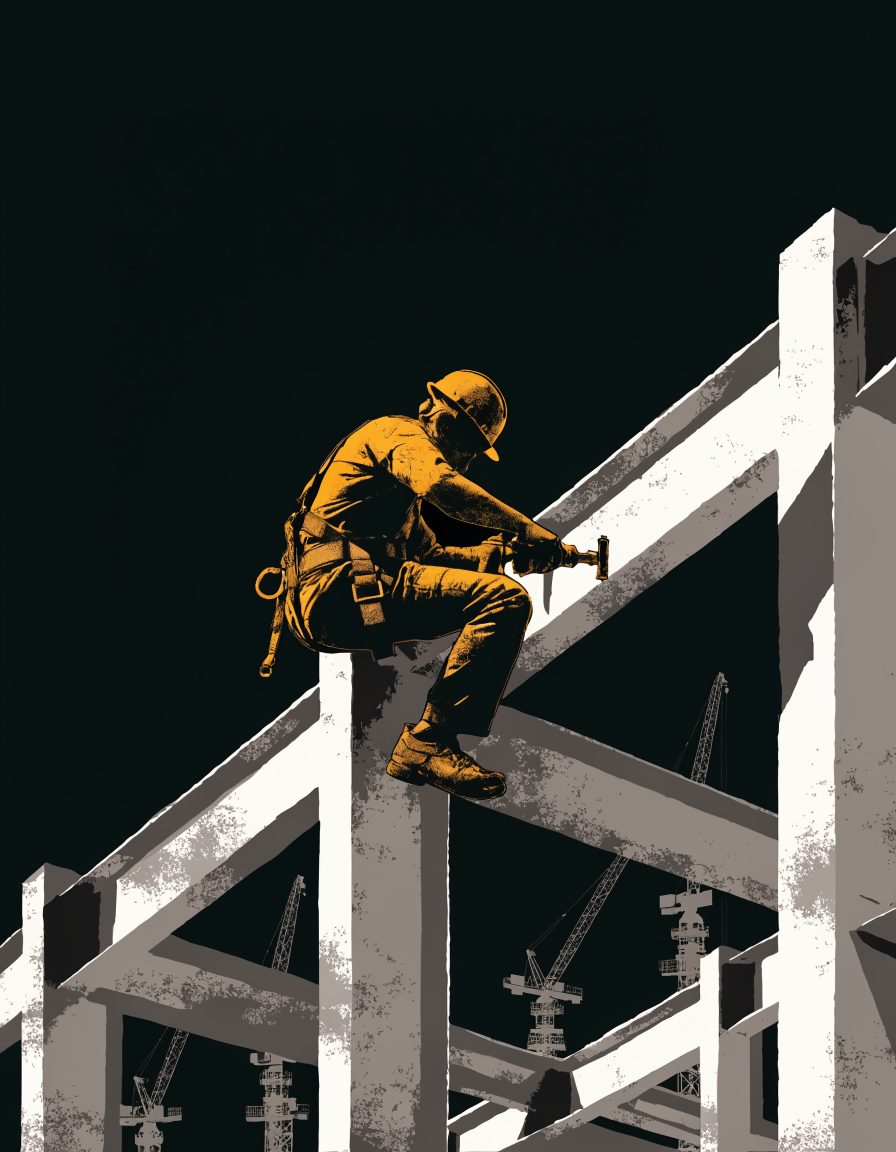
The trade
What an ironworker does.
Ironworkers (also known as structural steel erectors under CCQ classification) fabricate, erect, and assemble every iron and steel component for buildings, bridges, overpasses, and other structures, using bolting, welding, rigging, and assembly of beams, columns, stairs, and architectural metal elements. They work at height on large-scale sites and must handle lifting equipment and specialized tools while meeting strict safety standards.
CCQ rate
$47.85 – $51.32 / hour (journeyperson, by sector, April 26, 2026)
Hourly rates are set by the collective agreements of Québec's construction industry and vary by sector: $47.85/h in light residential, $50.66/h in heavy residential, $51.31/h in institutional-commercial and industrial and $51.32/h in civil engineering and roads (journeyperson rate, effective April 26, 2026). Apprentices earn a percentage of that rate depending on their apprenticeship period. Official grids published by the ACQ (residential and institutional-commercial-industrial) and the ACRGTQ (civil engineering and roads).
Source: official ACQ and ACRGTQ rate grids.
Why it's tight
The pool is thin. Speed makes the difference.
In 2024, 698 companies were recruiting structural steel erectors against 3,596 active workers, of whom only 966 were apprentices — a ratio that shows the pressure on the pipeline. Only 186 new apprentices were admitted into the trade in 2024, not enough to offset anticipated retirements in an aging workforce. The CCQ officially rates job prospects for this trade as 'excellent.' Add to that numerous major infrastructure projects underway in Quebec (the Montreal Metro Blue Line extension, major civil engineering and institutional projects across several regions), which are driving up demand for qualified journeypersons.
That's exactly where Aplomb wins: Audrey activates candidates in under 2 minutes, 24/7. While others call back the next day, your ironworker is already talking to us.
What we check
Before it lands on your desk.
- Valid CCQ journeyperson (CCC) or apprentice (CCA) competency certificate
- Completed the DEP in Structural and Architectural Erection (5364) or a CCQ-recognized equivalent
- Hold the ASP Construction card (general construction site health and safety)
- Skilled at reading structural steel plans and applying bolting, rigging, and assembly techniques at height
- Practical experience on institutional, industrial, or civil engineering sites (steel structures, bridges, multi-storey buildings)
Competency card
How an ironworker qualifies.
This trade is regulated by the CCQ under the R-20 Act. To enter the trade, a candidate must obtain an apprentice competency certificate (CCA) — issued on presentation of the DEP in Structural and Architectural Erection (5364, 1,230 hours) and a job guarantee of at least 150 hours from a CCQ-registered employer, plus passing the General Construction Site Health and Safety course (ASP Construction). The apprenticeship covers 3 periods of 2,000 hours each (6,000 hours total). At the end, the worker sits the provincial qualification exam (3 hours, 60 questions, 60% pass threshold) to earn the journeyperson competency certificate (CCC). The regulatory apprentice-to-journeyperson ratio is 1 apprentice per 2 journeypersons in industrial, institutional-commercial, and civil engineering and roads; 1:1 in residential.
Frequently asked questions
Hiring an ironworker, plainly.
What apprentice-to-journeyperson ratio do I need to respect on my sites?
In industrial, institutional-commercial, and civil engineering and roads, the regulatory ratio is 1 apprentice per 2 journeypersons (2-1). In residential, it's 1:1. Exceptions allow up to 2 apprentices per journeyperson under certain conditions (apprentice in final period or a female apprentice) — these don't stack. With only 186 new apprentices admitted in 2024 against 3,596 active workers overall, using the higher allowed ratio where conditions permit can help you train more people per journeyperson. This trade's excellent job-prospects rating from the CCQ also means competition for available apprentices is likely to stay high. Since 698 companies were competing to recruit from a pool of 3,596 active workers in 2024, only 966 of them apprentices, using the higher ratio where your sector allows it is often the difference between hitting a project deadline and falling behind.
How do I find available ironworkers?
The CCQ runs a workforce referral service for registered employers. In high-demand periods, targeting DEP graduates from the Structural and Architectural Erection program (offered in Montreal) and workers looking for new hours is a solid move. Posting your openings on construction-focused job platforms also speeds up recruiting. The numbers explain why it's competitive: 698 companies were recruiting structural steel erectors in 2024 against 3,596 active workers, only 966 of them apprentices. Major projects like the Montreal Metro Blue Line extension are pulling from the same limited pool, so building a relationship with the DEP program in Montreal ahead of time can pay off. Rates for journeypersons run $47.85 to $51.32 an hour depending on sector, so factor that into what you're offering when competing for a limited pool of 3,596 active workers.
What should I check before hiring an ironworker?
Confirm the worker holds a valid CCQ competency certificate (journeyperson or apprentice) — you can verify this on the CCQ's employer portal. Make sure their ASP Construction card is current. For work at height or involving welding, also confirm the specific certifications your sites require. Given the physical demands of the trade — bolting, rigging, and assembly work done at height with specialized lifting equipment — it's also worth confirming hands-on experience on the type of structure you're building, whether that's a multi-storey building, a bridge, or an industrial steel frame. The CCQ rates job prospects for this trade as excellent, so strong candidates don't stay available long. Given the CCQ rates prospects for this trade as excellent, with only 186 new apprentices admitted in 2024, credential checks are worth doing quickly before a strong candidate takes another offer.
Why Aplomb
Why not a generalist agency?
Hiring an ironworker isn't something you wing. CCQ specialization changes what you get.
Card verified
We read the CCQ card.
We verify the competency card — apprentice (CCA) or journeyperson (CCC) — before we send you anyone. A generalist doesn't know the difference; on the job site, it changes everything.
Ratios & sectors
We know your ratios.
Your sectors — institutional-commercial, industrial, civil engineering and roads, residential — each have their own apprentice/journeyperson ratio rules. A wrong ratio on the books means a stopped job site. We know them.
Construction only
Zero scatter.
We recruit CCQ-carded construction trades in Québec — not 40 industries at once. It's the talent pool we work every single day.
Get started
Need an ironworker?
Leave your info. We'll call you back quickly to understand the role — and tell you how we'll fill it, guarantee included.
- Clear mandate, no surprise quotes.
- 90-day replacement guarantee.
- We respond to candidates in <2 min, 24/7.
Hire an ironworker
We'll call you back quickly. No surprise quotes.
Prefer to talk to a human? 1 877 521-6345
Also by region
ironworkers in your area.
We recruit across Québec. See the candidate job pages by region for this trade.
Ironworker · Greater Montréal
Candidate job page →
Ironworker · Montérégie
Candidate job page →
Ironworker · Laurentides
Candidate job page →
Ironworker · Lanaudière
Candidate job page →
Ironworker · Capitale-Nationale (Quebec City area)
Candidate job page →
Ironworker · Chaudière-Appalaches
Candidate job page →
Ironworker · Outaouais
Candidate job page →
Ironworker · Estrie (Eastern Townships)
Candidate job page →
Ironworker · Mauricie
Candidate job page →
Ironworker · Centre-du-Québec
Candidate job page →
Ironworker · Saguenay–Lac-Saint-Jean
Candidate job page →
Ironworker · Abitibi-Témiscamingue
Candidate job page →