CCQ trade · Boilermaker
Boilermaker in Québec: wage, competency card and outlook.
What a boilermaker does, what it pays under the CCQ, how you get your competency card, and where the market is headed. The facts, sourced, no fluff.
$47.85 to $50.79 / hr CCQ journeyperson rate by sector · in effect since April 26, 2026
CCQ wage
How much does a boilermaker earn in Québec?
$47.85 – $50.79 / hour (journeyperson, by sector, April 26, 2026)
Hourly rates are set by the collective agreements of Québec's construction industry and vary by sector: $47.85/h in light residential, $50.20/h in heavy residential, $50.79/h in institutional-commercial and industrial and $50.79/h in civil engineering and roads (journeyperson rate, effective April 26, 2026). Apprentices earn a percentage of that rate depending on their apprenticeship period. Official grids published by the ACQ (residential and institutional-commercial-industrial) and the ACRGTQ (civil engineering and roads).
| Sector | Journeyperson rate |
|---|---|
| Light residential | $47.85/hr |
| Heavy residential | $50.20/hr |
| Institutional-commercial & industrial | $50.79/hr |
| Civil engineering & roadwork | $50.79/hr |
The trade
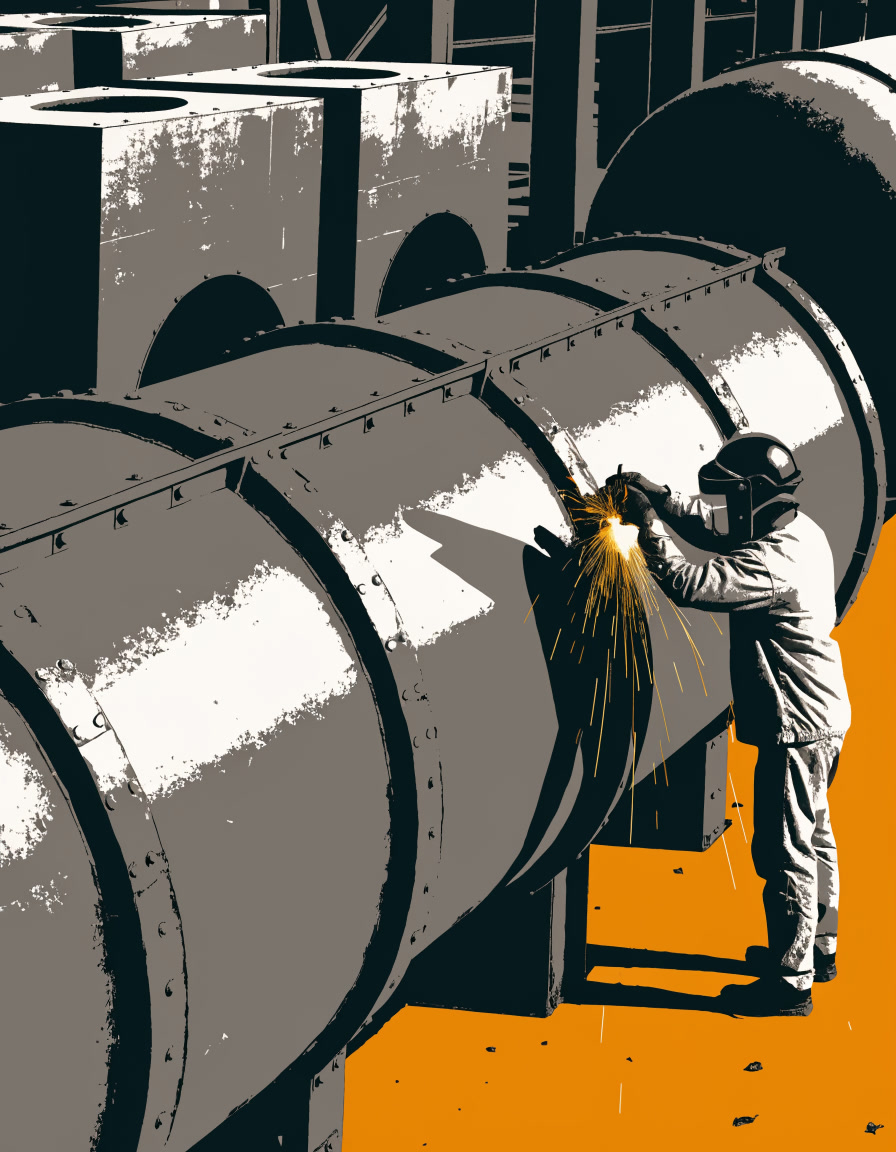
Boilermakers fabricate, build, assemble, erect, dismantle, and maintain a range of vessels, tanks, towers, and boilers, mainly on industrial job sites. They apply rigging, bolting, oxy-cutting, welding, and composite material assembly processes, read plans and specs, and often work at height and in awkward positions on pressurized equipment.
Competency card
How to become a CCQ-carded boilermaker.
Boilermakers fall under the "trades" category and must hold a CCQ competency certificate to work on job sites governed by the R-20 Act. The apprentice competency certificate (CCA) is issued after completing the DEP in Boilermaking (5356, 1,290 hours, generally offered in Montréal) and presenting a job guarantee of at least 150 hours over 3 consecutive months with a CCQ-registered employer. Once the apprentice holds the CCA, they must complete 3 apprenticeship periods of 2,000 hours each (6,000 hours total) before sitting the provincial qualification exam, which leads to the journeyperson competency certificate (CCC). The applicable apprentice-to-journeyperson ratio is set by the CCQ by sector: confirm it on ccq.org before hiring.
Outlook
The boilermaker market, per the CCQ.
In 2024, 682 boilermakers were active on Quebec job sites and 69 companies were recruiting them. The CCQ rates job prospects as "very good": even though demand for the trade is trending slightly down, a significantly aging workforce and too few new graduates are creating worker needs in the market. The average age of journeyperson boilermakers has reached 44.6, and 23% are 55 or older — a sign of a retirement wave ahead. Only 35 new apprentices were admitted into the trade in 2024, above the 2020-2023 average of 20 per year, but still modest for a pool this size. Mobility is high: 66% of boilermakers travel between regions, versus 16% for all trades combined.
What it takes
The skills in demand.
- Valid CCQ competency certificate (apprentice or journeyperson) — mandatory to work on job sites governed by the R-20 Act
- Completed DEP in Boilermaking (5356) or a CCQ-recognized equivalent
- ASP Construction card (general health and safety on construction sites)
- Skilled in welding, oxy-cutting, rigging, and bolting processes, and able to read plans and technical specs
- Experience in the industrial sector — 95% of the trade's work volume — particularly on vessels, tanks, towers, and boilers
Frequently asked questions
The boilermaker trade, plainly.
I have my DEP in Boilermaking. How do I get my CCQ card to work on job sites?
You need to show the CCQ proof you've completed your DEP in Boilermaking (5356) and present a job guarantee from a CCQ-registered employer of at least 150 hours over 3 consecutive months. That gets you the apprentice competency certificate (CCA). From there, you log 3 apprenticeship periods of 2,000 hours each — 6,000 hours total on site — then sit the provincial qualification exam to earn the journeyperson competency certificate (CCC). The DEP in Boilermaking runs 1,290 hours and is generally offered in Montréal. Good to know: the CCQ rates job prospects for this trade as "very good," and only 35 new apprentices were admitted into the industry in 2024, which leaves room for the new wave entering now.
Which sector will I work in most often as a boilermaker?
95% of the time, you'll be working in the industrial sector — plants, smelters, refineries, pulp and paper mills, power stations, and large industrial complexes. Civil engineering and roads accounts for 4% of the volume, institutional-commercial 1%, and residential is virtually nonexistent (0%). Day to day, expect fabrication, assembly, and maintenance of vessels, tanks, towers, and boilers, using welding, oxy-cutting, rigging, and bolting processes. It's a trade where working at height and in awkward positions is part of the reality. The CCQ indicates the industrial sector should stay stable in the coming years, and that civil engineering and roads should keep offering a solid volume of work — good news on both counts for job stability.
Will I have to travel for work as a boilermaker?
Probably, yes — and it's one of the trade's defining features. In 2024, 66% of boilermakers travelled between regions for work, compared to just 16% across all construction trades. That's one of the highest mobility rates in the industry, since major industrial job sites (refineries, smelters, power stations) aren't concentrated in a single region. In 2024, active boilermakers were spread out across the province: 142 in Laval-Laurentides-Lanaudière, 99 in Montérégie, 90 in Québec City, 84 in Mauricie–Bois-Francs, and 74 in Saguenay–Lac-Saint-Jean, among others. If you're willing to follow the projects, your ability to travel becomes a real asset for finding work quickly and stringing together contracts.
Sector breakdown, regional mobility and apprenticeship progression figures are drawn from Commission de la construction du Québec data. Hourly rates: official grids published by the ACQ (residential, institutional-commercial and industrial) and the ACRGTQ (civil engineering and roads), in force since April 26, 2026. acq.org
Are you a boilermaker?
Find work near you.
We text you fast, and the employer pays — never you. Pick your area:
Hiring a boilermaker?
We bring you carded people, fast.
Permanent placement, 90-day guarantee, no surprise quotes. Candidate response in under 2 minutes.