CCQ trade · Bricklayer-Mason
Bricklayer-Mason in Québec: wage, competency card and outlook.
What a bricklayer-mason does, what it pays under the CCQ, how you get your competency card, and where the market is headed. The facts, sourced, no fluff.
$46.59 to $50.18 / hr CCQ journeyperson rate by sector · in effect since April 26, 2026
CCQ wage
How much does a bricklayer-mason earn in Québec?
$46.59 – $50.18 / hour (journeyperson, by sector, April 26, 2026)
Hourly rates are set by the collective agreements of Québec's construction industry and vary by sector: $46.59/h in light residential, $49.21/h in heavy residential, $49.57/h in institutional-commercial and industrial and $50.18/h in civil engineering and roads (journeyperson rate, effective April 26, 2026). Apprentices earn a percentage of that rate depending on their apprenticeship period. Official grids published by the ACQ (residential and institutional-commercial-industrial) and the ACRGTQ (civil engineering and roads).
| Sector | Journeyperson rate |
|---|---|
| Light residential | $46.59/hr |
| Heavy residential | $49.21/hr |
| Institutional-commercial & industrial | $49.57/hr |
| Civil engineering & roadwork | $50.18/hr |
The trade
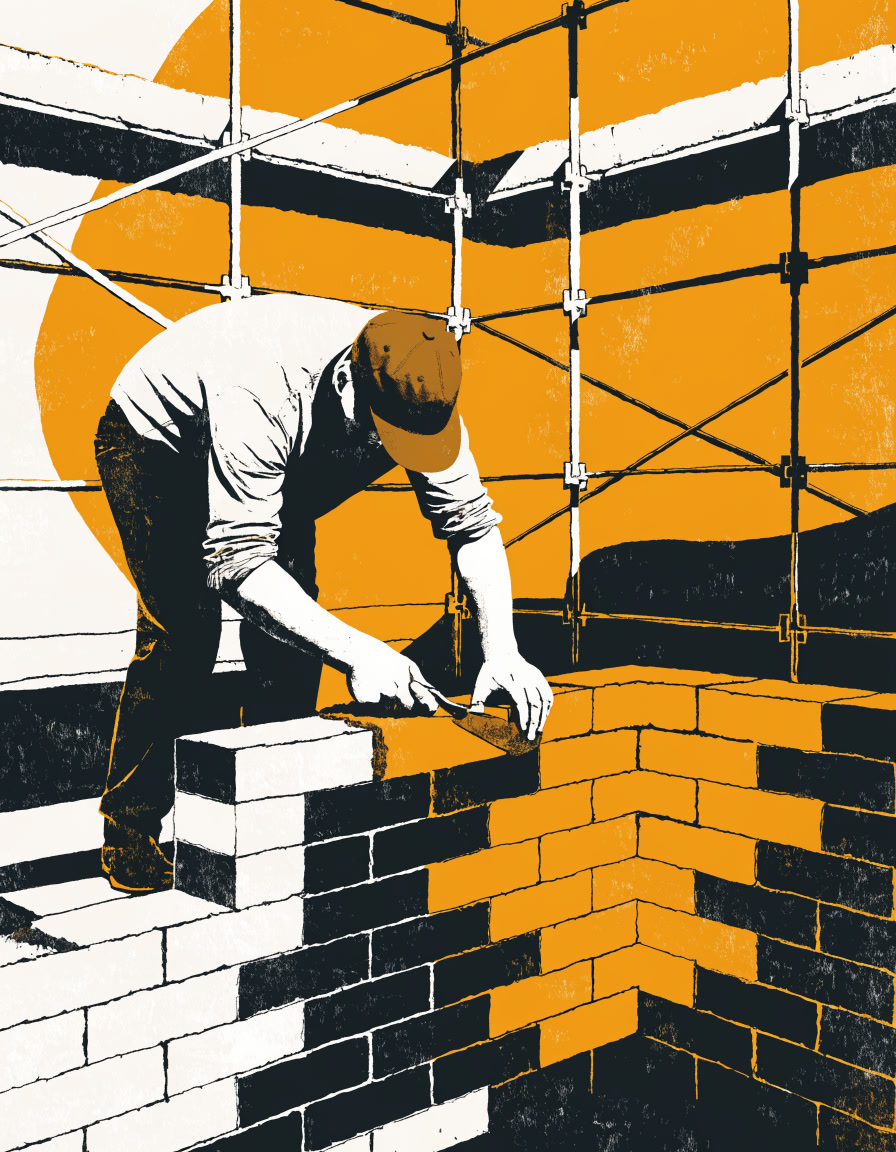
Bricklayer-masons lay brick, cut stone, glass block, dressed stone, and precast concrete architectural elements using mortar, cement, or other adhesives. They build and repair walls, partitions, fireplaces, and chimneys, and can specialize in heritage masonry restoration or refractory masonry on job sites of every size.
Competency card
How to become a CCQ-carded bricklayer-mason.
Bricklayer-masons must hold a CCQ competency card. The apprentice certificate (CCA) is issued after completing the DEP in Bricklaying-Masonry (program 5303, 900 hours) and presenting a job guarantee of at least 150 hours over 3 consecutive months with a CCQ-registered employer. The apprenticeship covers 3 periods of 2,000 hours each (6,000 hours total). After completing 85% of the apprenticeship, the apprentice can sit the provincial qualification exam (3 hours, 60 questions, 60% pass threshold) to earn the journeyperson certificate (CCC). The apprentice-to-journeyperson ratio is 1:1 in residential; in institutional-commercial, industrial, and civil engineering, bricklayer-masons require 2 journeypersons per apprentice on the books. A journeyperson can supervise a 2nd apprentice if one of them is in their final apprenticeship period or one is a woman (conditions are not cumulative).
Outlook
The bricklayer-mason market, per the CCQ.
In 2024, 5,256 bricklayer-masons were active on Quebec job sites, including 3,345 journeypersons, with an average age of 38.2 and 13% of the workforce 55 or older. The CCQ rates job prospects for the trade as "very good." In 2024, 421 new apprentices were admitted, up from the 2020-2023 average of 400 per year, while 1,243 companies were recruiting bricklayer-masons — a sign of an active market. The institutional-commercial sector alone accounts for 66% of hours worked by bricklayer-masons, directing most of the demand toward hospitals, schools, office buildings, and shopping centres. Interregional mobility stays moderate in this trade: 14% of workers travel between regions to follow job sites.
What it takes
The skills in demand.
- Valid CCQ competency certificate (apprentice or journeyperson) — mandatory to work on CCQ-regulated job sites
- ASP Construction card (general health and safety on job sites) — required to obtain the CCQ competency certificate
- Completed DEP in Bricklaying-Masonry (program 5303, 900 hours) or a CCQ-recognized equivalent
- Ability to read plans and lay brick, stone, glass block, and precast concrete elements to masonry standards and techniques
- Experience in the institutional-commercial sector (66% of hours worked in the trade) or in the employer's target sector
Frequently asked questions
The bricklayer-mason trade, plainly.
Do I absolutely need a DEP in Bricklaying-Masonry to get into the trade?
It's the most common and direct path: the DEP in Bricklaying-Masonry (program 5303, 900 hours) gets you a CCQ apprentice certificate right at graduation, provided you present a job guarantee of at least 150 hours over 3 consecutive months with a CCQ-registered employer. Other entry paths exist too (experience recognition, labour pools) — check ccq.org directly to see which one applies to your situation. Once you've got your certificate, the market is favourable: the CCQ rates job prospects for the trade as "very good." In 2024, 5,256 bricklayer-masons were active and 1,243 companies were recruiting, which gives you a solid shot at finding an employer quickly for your job guarantee.
How long before I'm a journeyperson at full rate?
You need to log 6,000 apprenticeship hours across 3 periods of 2,000 hours each, then pass the provincial qualification exam. Working full-time, that's roughly 3 to 4 years. You become eligible for the exam once you've completed 85% of your apprenticeship. The exam runs 3 hours, covers 60 questions, and requires a 60% pass threshold. Your rate climbs with each period: as a rough guide, an apprentice earns between $27.95 and $30.11/h in period 1, climbing to between $39.60 and $42.65/h in period 3 (April 26, 2026), before reaching the full journeyperson rate. The apprentice-to-journeyperson ratio also varies by sector: 1:1 in residential, but 2 journeypersons per apprentice in institutional-commercial, industrial, and civil engineering.
Which sector has the most work for a bricklayer-mason in Quebec?
Institutional-commercial accounted for 66% of hours worked by bricklayer-masons in 2024, followed by residential (23%), industrial (9%), and civil engineering and roads (2%). In practice, most positions are on commercial buildings, hospitals, schools, and office buildings. Also worth knowing: in institutional-commercial, industrial, and civil engineering, bricklayer-masons require 2 journeypersons per apprentice on the books, versus 1:1 in residential — that directly affects your odds of being hired as an apprentice depending on which sector you apply to. Interregional mobility stays moderate in the trade: only 14% of bricklayer-masons travel between regions, so work is often close to home.
Sector breakdown, regional mobility and apprenticeship progression figures are drawn from Commission de la construction du Québec data. Hourly rates: official grids published by the ACQ (residential, institutional-commercial and industrial) and the ACRGTQ (civil engineering and roads), in force since April 26, 2026. acq.org
Are you a bricklayer-mason?
Find work near you.
We text you fast, and the employer pays — never you. Pick your area:
Hiring a bricklayer-mason?
We bring you carded people, fast.
Permanent placement, 90-day guarantee, no surprise quotes. Candidate response in under 2 minutes.