Home/Trades/Fire Protection Mechanic (Sprinkler Fitter)
CCQ trade · Fire Protection Mechanic (Sprinkler Fitter)
Fire Protection Mechanic (Sprinkler Fitter) in Québec: wage, competency card and outlook.
What a fire protection mechanic (sprinkler fitter) does, what it pays under the CCQ, how you get your competency card, and where the market is headed. The facts, sourced, no fluff.
$47.85 to $50.87 / hr CCQ journeyperson rate by sector · in effect since April 26, 2026
CCQ wage
How much does a fire protection mechanic (sprinkler fitter) earn in Québec?
$47.85 – $50.87 / hour (journeyperson, by sector, April 26, 2026)
Hourly rates are set by the collective agreements of Québec's construction industry and vary by sector: $47.85/h in light residential, $50.20/h in heavy residential, $50.79/h in institutional-commercial and industrial and $50.87/h in civil engineering and roads (journeyperson rate, effective April 26, 2026). Apprentices earn a percentage of that rate depending on their apprenticeship period. Official grids published by the ACQ (residential and institutional-commercial-industrial) and the ACRGTQ (civil engineering and roads).
| Sector | Journeyperson rate |
|---|---|
| Light residential | $47.85/hr |
| Heavy residential | $50.20/hr |
| Institutional-commercial & industrial | $50.79/hr |
| Civil engineering & roadwork | $50.87/hr |
The trade
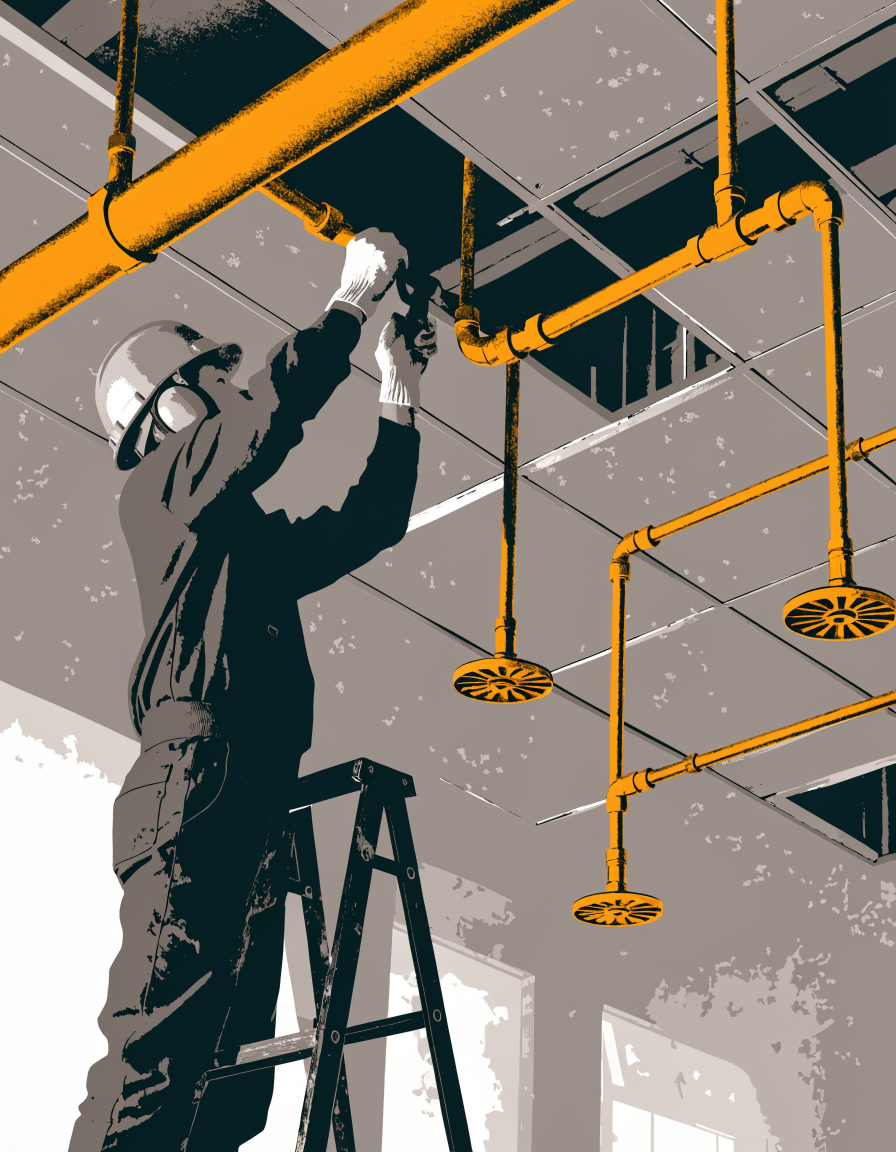
Fire protection mechanics (sprinkler fitters) install, modify, repair, and maintain automatic sprinkler systems — the piping and fittings that prevent and fight fires. They prepare, assemble, install, and connect piping and its accessories, then activate, test, and inspect sprinkler systems on institutional, commercial, and industrial job sites across Quebec.
Competency card
How to become a CCQ-carded fire protection mechanic (sprinkler fitter).
This trade is regulated by the CCQ. Entry starts with the apprentice competency certificate (CCA), earned by completing the DEP in Fire Protection Mechanics (5312, 900 hours, generally offered in the Laval region) and presenting a job guarantee of at least 150 hours over 3 consecutive months with a CCQ-registered employer. The apprenticeship covers 4 periods of 2,000 hours each (8,000 hours total), after which the apprentice can sit the provincial qualification exam leading to the journeyperson competency certificate (CCC). The apprentice-to-journeyperson ratio on the books is 1 journeyperson per apprentice, across all sectors. On site, a journeyperson can supervise a 2nd apprentice if one of them is in their final apprenticeship period or is a woman (these conditions don't stack).
Outlook
The fire protection mechanic (sprinkler fitter) market, per the CCQ.
In 2024, 1,747 fire protection mechanics were active on Quebec job sites, including 1,086 journeypersons, with an overall average age of 37.1 — a younger workforce than the industry average. The CCQ rates job prospects as excellent, driven by rising demand combined with low worker availability. In 2024, 148 companies were hiring in the trade, against only 118 new apprentices admitted that year. The work is not very seasonal: the annual average of hours worked ranks among the highest of all trades, and 90% of journeypersons log at least 500 hours a year. Mandatory preventive maintenance on sprinkler systems keeps demand stable, year after year.
What it takes
The skills in demand.
- Valid CCQ competency certificate (apprentice or journeyperson) — mandatory to work on CCQ-regulated job sites
- Completed DEP in Fire Protection Mechanics (5312) or a CCQ-recognized equivalent
- ASP Construction card (general health and safety on job sites) — required to obtain the CCQ competency certificate
- Ability to read and interpret plans and technical specs, and apply basic math, hydraulics, and electrical concepts
- Experience in the institutional-commercial sector, which accounts for 94% of hours worked in the trade; good physical condition and comfortable working on scaffolding
Frequently asked questions
The fire protection mechanic (sprinkler fitter) trade, plainly.
What does it take to become a fire protection mechanic?
It's the most direct path: the DEP in Fire Protection Mechanics (5312, 900 hours, generally offered in the Laval region) gets you a CCQ apprentice certificate as soon as you land a job guarantee of at least 150 hours over 3 consecutive months with a registered employer. From there, you log 8,000 apprenticeship hours across 4 periods of 2,000 hours each, then pass the provincial qualification exam to become a journeyperson. The timing works in your favour: the CCQ rates job prospects as excellent, driven by low worker availability. In 2024, 148 companies were hiring in the trade against only 118 new apprentices admitted — good odds of finding an employer to sign your job guarantee quickly.
Which sector will I work in as a fire protection mechanic?
Almost all the work is in institutional-commercial: that sector accounted for 94% of hours worked by fire protection mechanics in 2024, followed by industrial (5%) and civil engineering and roads (1%). Residential is practically nonexistent in this trade. In practice, you're installing and maintaining sprinkler systems in hospitals, schools, office towers, shopping centres, and factories. Mandatory preventive maintenance on these systems creates a steady, low-seasonality workflow — the annual average of hours worked actually ranks among the highest in the industry. On the wage side, the journeyperson rate in institutional-commercial reaches $50.79/hour (April 26, 2026), the highest on the grid for this trade.
Is this a well-paying, stable trade?
Yes. In 2024, the average annual salary for a journeyperson who worked at least 500 hours reached $86,960, and 90% of journeypersons clear that 500-hour threshold — a sign that work isn't hard to find in this trade. The work is not very seasonal, which means more hours year-round: the annual average of hours worked ranks among the highest of all construction trades. The CCQ rates job prospects as excellent, thanks to rising demand and low worker availability. Hourly, the journeyperson rate runs from $47.85 in residential up to $50.79 in institutional-commercial and industrial (April 26, 2026). Mandatory preventive maintenance on sprinkler systems guarantees recurring demand, independent of new-construction cycles.
Sector breakdown, regional mobility and apprenticeship progression figures are drawn from Commission de la construction du Québec data. Hourly rates: official grids published by the ACQ (residential, institutional-commercial and industrial) and the ACRGTQ (civil engineering and roads), in force since April 26, 2026. acq.org
Are you a fire protection mechanic (sprinkler fitter)?
Find work near you.
We text you fast, and the employer pays — never you. Pick your area:
Hiring a fire protection mechanic (sprinkler fitter)?
We bring you carded people, fast.
Permanent placement, 90-day guarantee, no surprise quotes. Candidate response in under 2 minutes.