Home/Trades/Reinforcing Steel Worker (Rodbuster)
CCQ trade · Reinforcing Steel Worker (Rodbuster)
Reinforcing Steel Worker (Rodbuster) in Québec: wage, competency card and outlook.
What a reinforcing steel worker (rodbuster) does, what it pays under the CCQ, how you get your competency card, and where the market is headed. The facts, sourced, no fluff.
$46.85 to $51.32 / hr CCQ journeyperson rate by sector · in effect since April 26, 2026
CCQ wage
How much does a reinforcing steel worker (rodbuster) earn in Québec?
$46.85 – $51.32 / hour (journeyperson, by sector, April 26, 2026)
Hourly rates are set by the collective agreements of Québec's construction industry and vary by sector: $46.85/h in light residential, $50.66/h in heavy residential, $51.31/h in institutional-commercial and industrial and $51.32/h in civil engineering and roads (journeyperson rate, effective April 26, 2026). Apprentices earn a percentage of that rate depending on their apprenticeship period. Official grids published by the ACQ (residential and institutional-commercial-industrial) and the ACRGTQ (civil engineering and roads).
| Sector | Journeyperson rate |
|---|---|
| Light residential | $46.85/hr |
| Heavy residential | $50.66/hr |
| Institutional-commercial & industrial | $51.31/hr |
| Civil engineering & roadwork | $51.32/hr |
The trade
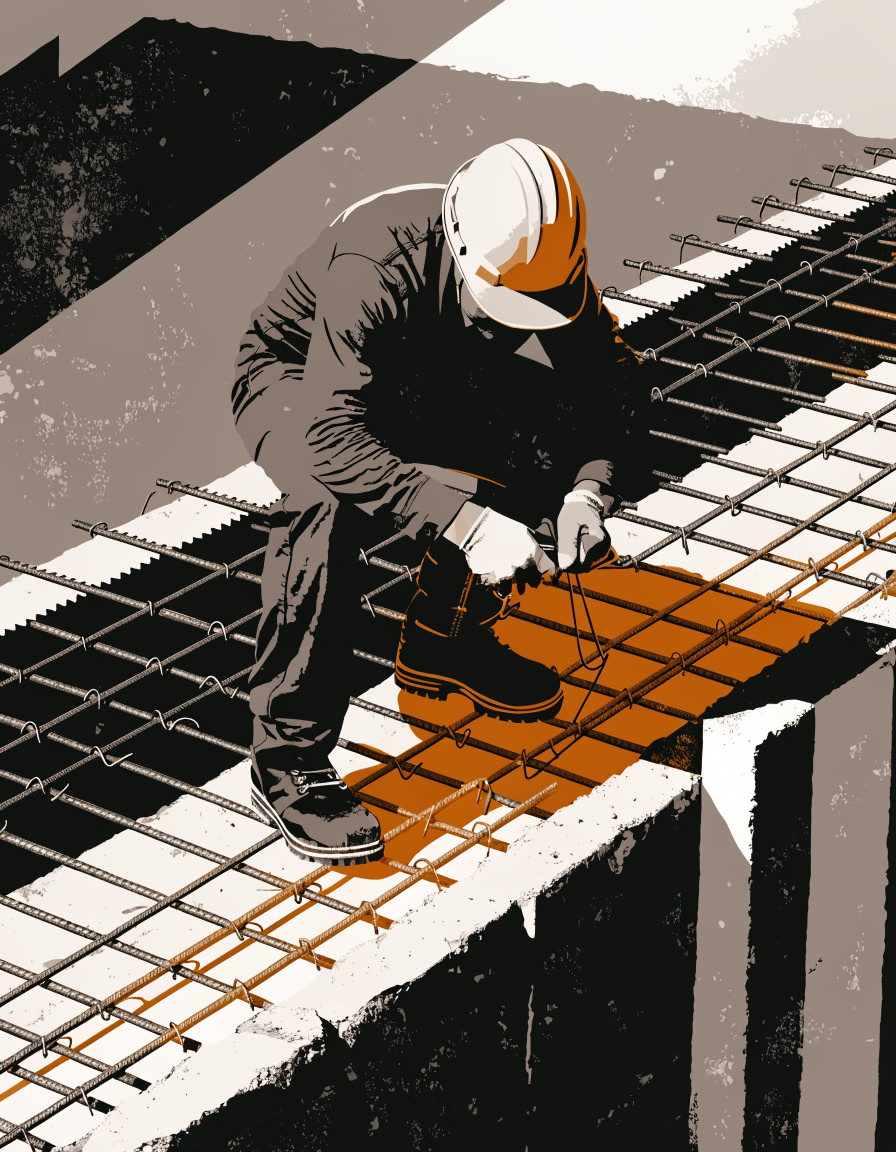
Reinforcing steel workers (rodbusters) place steel rebar, wire mesh, and other reinforcement used to strengthen concrete. They cut, bend, shape, tie, weld, and install reinforcing steel in footings, slabs, walls, columns, and reinforced concrete structures. They read formwork and rebar plans, position steel according to specifications, and ensure the structural integrity of the work on job sites of every size.
Competency card
How to become a CCQ-carded reinforcing steel worker (rodbuster).
Reinforcing steel worker (specialty 'concrete reinforcement placement') is a trade covered by the R-20 Act and regulated by the CCQ. The main entry path is the DEP in Concrete Reinforcement Placement (program 5076, 735 hours), which grants access to the apprentice competency certificate (CCA) upon presenting a job guarantee of at least 150 hours spread over 3 consecutive months with a CCQ-registered employer. The apprentice then completes a single apprenticeship period of 2,000 hours, after which they can sit the provincial qualification exam — passing it leads to the journeyperson competency certificate (CCC). The applicable apprentice-to-journeyperson ratio varies by sector and isn't published on the CCQ's trade profile page: check the official ratio grid on ccq.org before assigning apprentices to a job site.
Outlook
The reinforcing steel worker (rodbuster) market, per the CCQ.
In 2024, 1,865 reinforcing steel workers were active on Quebec job sites (1,496 journeypersons and 369 apprentices), and 257 companies were hiring — a high number of employers relative to the available pool. Only 152 new apprentices were admitted into the trade that year. The average age of journeypersons is 39.2. The CCQ rates the reinforcing steel worker's employment outlook as excellent, due to low workforce availability, a high turnover rate, and not enough graduates to meet job-site demand. The trade is also highly mobile: 39% of reinforcing steel workers travel between regions to follow projects, a sign that demand outstrips the local supply in several regions of Quebec.
What it takes
The skills in demand.
- Valid CCQ competency certificate (apprentice or journeyperson) — mandatory to work on CCQ-regulated job sites
- Completion of the DEP in Concrete Reinforcement Placement (5076) or an equivalent training recognized by the CCQ
- ASP Construction card (general health and safety on job sites) — required to obtain the CCQ competency certificate
- Proficiency in reading rebar and formwork plans, along with cutting, bending, shaping, tying, and welding reinforcing steel
- Experience in the institutional-commercial sector, which accounts for 72% of hours worked by reinforcing steel workers, or in civil engineering and roads (20%)
Frequently asked questions
The reinforcing steel worker (rodbuster) trade, plainly.
I have my DEP in Concrete Reinforcement Placement. How do I get my CCQ card to work on job sites?
You need to present your completed DEP in Concrete Reinforcement Placement (5076, 735 hours) to the CCQ and have a job guarantee of at least 150 hours spread over 3 consecutive months with a CCQ-registered employer. That gets you the apprentice competency certificate (CCA). From there, you complete a single apprenticeship period of 2,000 hours on job sites, then sit the provincial qualification exam — passing it earns you the journeyperson competency certificate (CCC). It's one of the shortest paths among the construction trades, which means you reach full rate relatively quickly. The market is favourable too: in 2024, 257 companies were hiring reinforcing steel workers in Quebec, which helps you quickly find the employer you need for your job guarantee.
Which sector will I work in most often as a reinforcing steel worker?
In 2024, 72% of hours worked by reinforcing steel workers in Quebec were in the institutional-commercial sector — hospitals, schools, office buildings, parking structures. Civil engineering and roads accounted for 20% of hours (bridges, overpasses, infrastructure), industrial 7%, and residential just 1%. In practice, you'll spend most of your time cutting, bending, tying, and installing reinforcing steel in footings, slabs, walls, and columns of reinforced concrete on large job sites. That's reflected in the pay too: the journeyperson rate runs from $46.85/h in light residential up to $51.31/h in institutional-commercial and $51.32/h in civil engineering and roads (April 26, 2026). Starting out in institutional-commercial or civil engineering puts you where both the volume of work and the best rates are.
Is now a good time to get into the reinforcing steel worker trade in Quebec?
Yes. The CCQ rates the reinforcing steel worker's employment outlook as excellent, due to low workforce availability, a high turnover rate, and not enough graduates to meet demand. The numbers back it up: in 2024, there were 1,865 active reinforcing steel workers in Quebec (1,496 journeypersons, 369 apprentices) and 257 companies hiring, but only 152 new apprentices admitted into the trade that year. The average age of journeypersons is 39.2. The trade is also highly mobile: 39% of reinforcing steel workers travel between regions to follow projects, compared to a minority in many other trades. With a short qualification path (a single 2,000-hour apprenticeship period) and sustained demand, getting into the trade now works clearly in your favour.
Sector breakdown, regional mobility and apprenticeship progression figures are drawn from Commission de la construction du Québec data. Hourly rates: official grids published by the ACQ (residential, institutional-commercial and industrial) and the ACRGTQ (civil engineering and roads), in force since April 26, 2026. acq.org
Are you a reinforcing steel worker (rodbuster)?
Find work near you.
We text you fast, and the employer pays — never you. Pick your area:
Hiring a reinforcing steel worker (rodbuster)?
We bring you carded people, fast.
Permanent placement, 90-day guarantee, no surprise quotes. Candidate response in under 2 minutes.