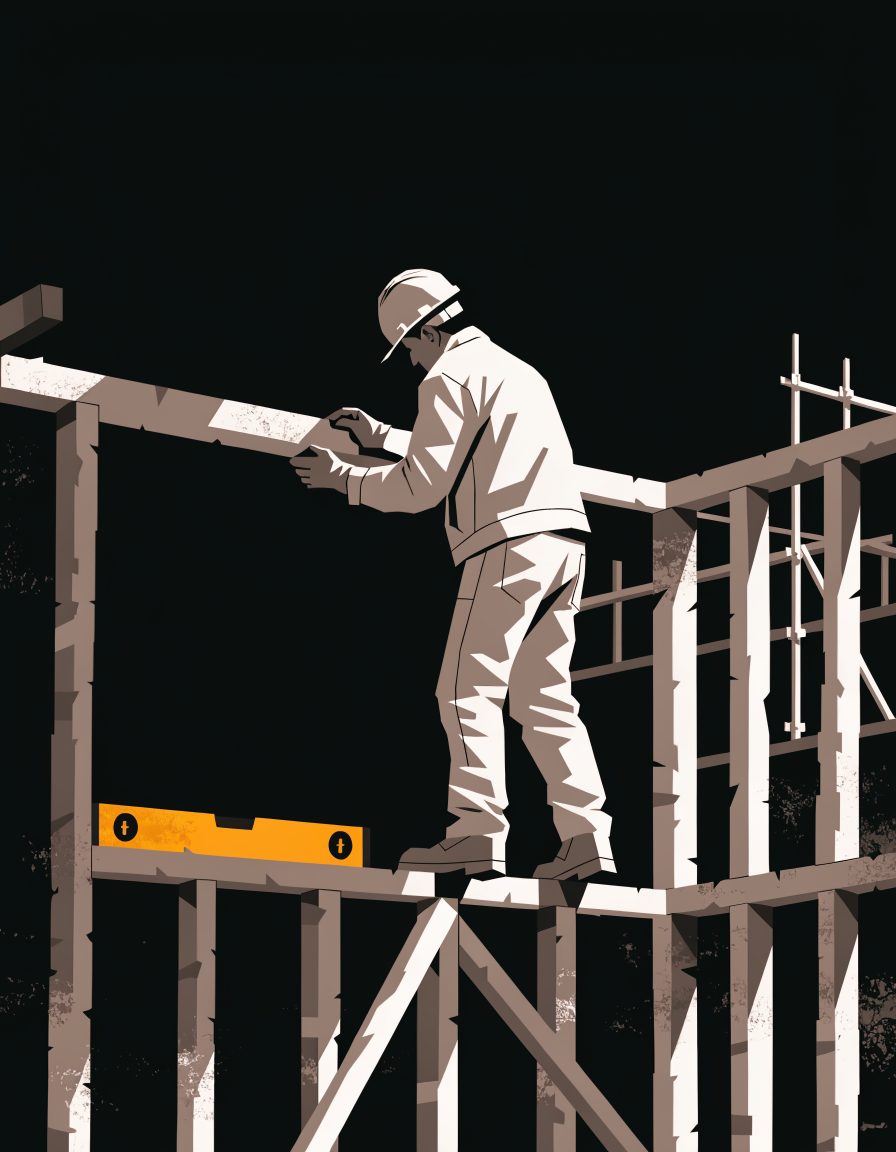
The trade
What a carpenter does.
Carpenters build and install a building's wood and metal structures: wall, floor, and roof framing, formwork, exterior cladding, doors, windows, stairs, interior partitions, and built-in millwork. They work on job sites of every size, from small residential to large institutional and industrial projects.
CCQ rate
$45.76 – $50.24 / hour (journeyperson, by sector, April 26, 2026)
Hourly rates are set by the collective agreements of Québec's construction industry and vary by sector: $45.76/h in light residential, $49.61/h in heavy residential, $50.16/h in institutional-commercial and industrial and $50.24/h in civil engineering and roads (journeyperson rate, effective April 26, 2026). Apprentices earn a percentage of that rate depending on their apprenticeship period. Official grids published by the ACQ (residential and institutional-commercial-industrial) and the ACRGTQ (civil engineering and roads).
Source: official ACQ and ACRGTQ rate grids.
Why it's tight
The pool is thin. Speed makes the difference.
The CCQ counted 55,280 active carpentry workers in 2024, against only 3,899 new apprentices admitted that year — well below the annual average of 5,263. Industry-wide, the CCQ projects a need for 17,000 new recruits per year for 2024-2028, combining retirements and growing work volume. The average age in the trade is 37.7, and women make up only 2.6% of the workforce, leaving significant room to widen the recruiting pool. Strong demand in housing and major institutional projects across Quebec keeps this trade at the top of the recruiting priority list.
That's exactly where Aplomb wins: Audrey activates candidates in under 2 minutes, 24/7. While others call back the next day, your carpenter is already talking to us.
What we check
Before it lands on your desk.
- Valid CCQ competency card (apprentice or journeyperson, trade 160)
- General Construction Site Health and Safety course (30 hours, ASP Construction)
- Ability to read and interpret plans and technical specs
- Experience in the target sector (residential, ICI, or civil engineering)
- DEP in Carpentry (program 5319) or a CCQ-recognized equivalent
Competency card
How a carpenter qualifies.
The CCQ issues two competency cards for this trade. The apprentice card (CCA) is earned after a DEP in Carpentry (1,350 hours, program 5319) and a job guarantee of 150 hours over three consecutive months with a registered employer. The journeyperson card (CCC) requires 6,000 hours across three apprenticeship periods of 2,000 hours each, followed by the provincial qualification exam. Separate specialties (formworker, deep foundation installer, floor sander-finisher) require only 4,000 hours (two periods). The apprentice-to-journeyperson ratio is 1:1 across all sectors; in industrial, institutional-commercial, and civil engineering, a journeyperson can supervise two apprentices if one is in their final period or one is a woman.
Frequently asked questions
Hiring a carpenter, plainly.
What apprentice-to-journeyperson ratio do I need to respect for this trade?
Across all sectors, the base rule is one journeyperson per apprentice on the same workday. In industrial, institutional-commercial, and civil engineering and roads, a journeyperson can supervise two apprentices if one is in their final apprenticeship period or one is a woman. In residential, the ratio stays strictly 1:1. This flexibility is worth using given the numbers: only 3,899 new apprentices were admitted in 2024 against an annual average of 5,263, so training more apprentices per journeyperson where the rules allow can help offset the gap. Carpentry also remains the CCQ's largest trade by headcount, with 55,280 active workers in 2024, so ratio compliance affects a lot of crews. With the trade's average age at 37.7, using the flexible ratio where it applies helps bring on apprentices faster than a strict 1:1 crew allows.
Is the shortage real? Is it hard to recruit a journeyperson carpenter right now?
Yes, the pressure is real and documented by the CCQ. In 2024, only 3,899 new apprentices were admitted into the trade, well below the annual average of 5,263. With 55,280 active workers and an average age of 37.7, retirements will pick up. The CCQ lets you activate a regional 'shortage alert' to get notified as soon as a labour pool opens. The CCQ projects a need for 17,000 new recruits per year across the whole industry through 2028, and carpentry's sheer size — 55,280 active workers — means it absorbs a large share of that pressure. With women still just 2.6% of the workforce, employers actively recruiting outside the traditional pipeline may find an underused source of candidates. Strong ongoing demand in both housing and major institutional projects across Quebec means that pressure isn't expected to ease soon.
Can I hire someone without a CCQ card if I put them through training?
No. On sites governed by the R-20 Act, every worker must hold a valid CCQ competency card before starting work. The CCQ does provide entry paths for people without a DEP (labour pools, experience recognition) — but the card has to be issued before the first hour on site. Also confirm the card matches the actual work: specialties like formworker, deep foundation installer, or floor sander-finisher are issued after only 4,000 apprenticeship hours instead of the full 6,000, so a specialty card doesn't necessarily cover general carpentry tasks. Given the trade's 30-hour ASP Construction requirement, verify that health and safety training is current too. Since carpentry covers everything from framing and formwork to doors, windows, stairs, and built-in millwork, confirming the card matches the actual scope of work also protects you from liability if a project inspector asks for proof.
Why Aplomb
Why not a generalist agency?
Hiring a carpenter isn't something you wing. CCQ specialization changes what you get.
Card verified
We read the CCQ card.
We verify the competency card — apprentice (CCA) or journeyperson (CCC) — before we send you anyone. A generalist doesn't know the difference; on the job site, it changes everything.
Ratios & sectors
We know your ratios.
Your sectors — residential, institutional-commercial, industrial, civil engineering and roads — each have their own apprentice/journeyperson ratio rules. A wrong ratio on the books means a stopped job site. We know them.
Construction only
Zero scatter.
We recruit CCQ-carded construction trades in Québec — not 40 industries at once. It's the talent pool we work every single day.
Get started
Need a carpenter?
Leave your info. We'll call you back quickly to understand the role — and tell you how we'll fill it, guarantee included.
- Clear mandate, no surprise quotes.
- 90-day replacement guarantee.
- We respond to candidates in <2 min, 24/7.
Hire a carpenter
We'll call you back quickly. No surprise quotes.
Prefer to talk to a human? 1 877 521-6345
Also by region
carpenters in your area.
We recruit across Québec. See the candidate job pages by region for this trade.
Carpenter · Greater Montréal
Candidate job page →
Carpenter · Montérégie
Candidate job page →
Carpenter · Laurentides
Candidate job page →
Carpenter · Lanaudière
Candidate job page →
Carpenter · Capitale-Nationale (Quebec City area)
Candidate job page →
Carpenter · Chaudière-Appalaches
Candidate job page →
Carpenter · Outaouais
Candidate job page →
Carpenter · Estrie (Eastern Townships)
Candidate job page →
Carpenter · Mauricie
Candidate job page →
Carpenter · Centre-du-Québec
Candidate job page →
Carpenter · Saguenay–Lac-Saint-Jean
Candidate job page →
Carpenter · Abitibi-Témiscamingue
Candidate job page →