The trade
What an elevator mechanic does.
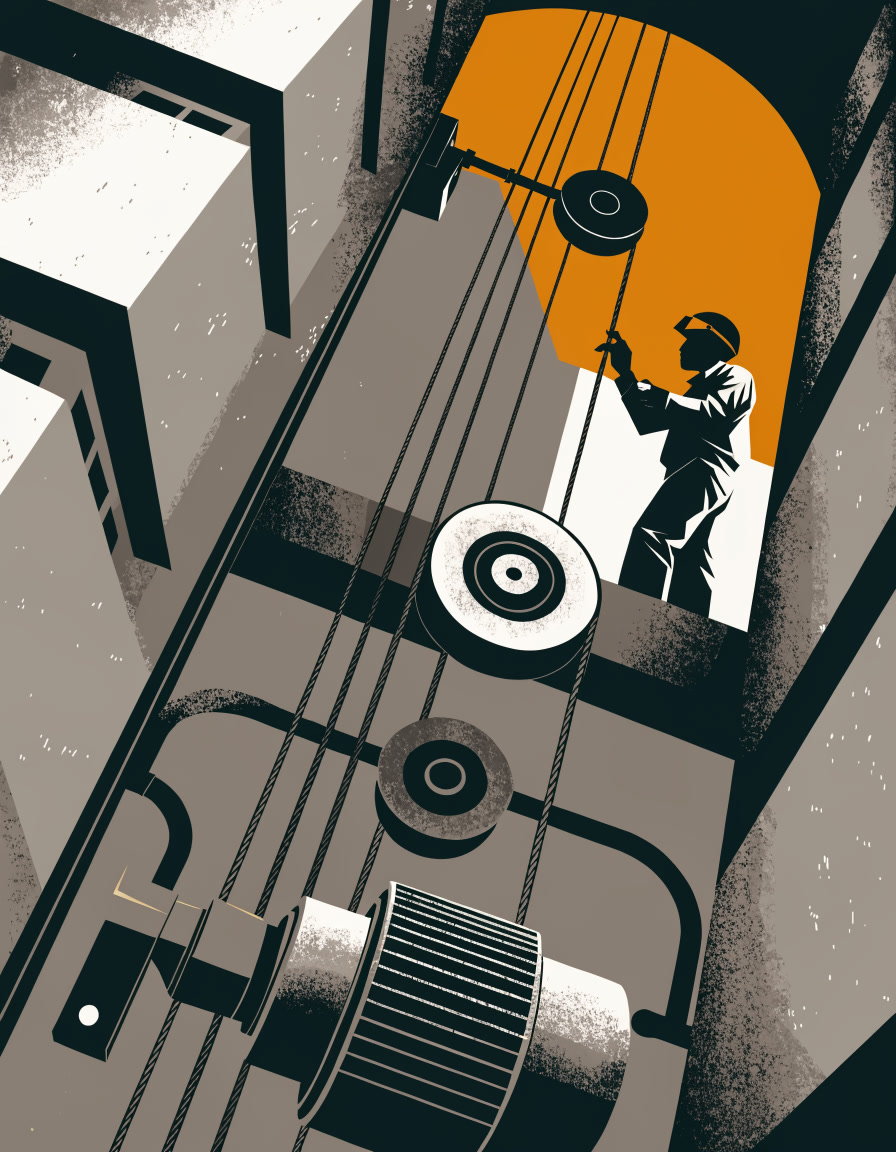
Elevator mechanics install, repair, modify, and maintain mechanized transportation systems — traction and hydraulic elevators, escalators, freight elevators, and moving walkways — on construction sites. They read plans, apply current codes, and commission complex electromechanical equipment in buildings of every height, from small commercial buildings to institutional towers.
CCQ rate
$52.95 – $56.70 / hour (journeyperson, by sector, April 26, 2026)
Hourly rates are set by the collective agreements of Québec's construction industry and vary by sector: $52.95/h in light residential, $55.63/h in heavy residential, $56.70/h in institutional-commercial and industrial and $56.70/h in civil engineering and roads (journeyperson rate, effective April 26, 2026). Apprentices earn a percentage of that rate depending on their apprenticeship period. Official grids published by the ACQ (residential and institutional-commercial-industrial) and the ACRGTQ (civil engineering and roads).
Source: official ACQ and ACRGTQ rate grids.
Why it's tight
The pool is thin. Speed makes the difference.
In 2024, 1,327 elevator mechanics were active on Quebec job sites — 882 journeypersons and 445 apprentices — with an average age of 39.3. Only 71 new apprentices were admitted into the trade that year, a thin pipeline given the industry's longest apprenticeship (10,000 hours). The CCQ rates job prospects for this trade as excellent. Demand is concentrated in institutional-commercial (97% of work volume), driven by construction of medium- and high-rise buildings and by modernization of the existing elevator stock. Journeypersons who worked at least 500 hours in the year averaged an annual salary of $106,947 in 2024, one of the highest among construction trades. Interregional mobility remains low (12%), a sign of a workforce concentrated near major urban centres.
That's exactly where Aplomb wins: Audrey activates candidates in under 2 minutes, 24/7. While others call back the next day, your elevator mechanic is already talking to us.
What we check
Before it lands on your desk.
- Valid CCQ competency certificate (apprentice CCA or journeyperson CCC) — mandatory to work on job sites governed by the R-20 Act
- Completed DEP in Elevator Mechanics (5337) or a CCQ-recognized equivalent
- ASP Construction card (general health and safety on construction sites)
- Mastery of traction, hydraulic, and electromechanical systems, plus the ability to read plans and apply current codes
- Experience in institutional-commercial, the sector holding 97% of hours worked in the trade
Competency card
How an elevator mechanic qualifies.
The elevator mechanic trade is regulated by the CCQ. Entry starts with the apprentice competency certificate (CCA), earned after completing the DEP in Elevator Mechanics (5337, 1,800 hours) and a job guarantee of at least 150 hours over 3 consecutive months with a CCQ-registered employer. The apprenticeship covers 5 periods of 2,000 hours each (10,000 hours total) — the longest apprenticeship of any construction trade in Quebec. After those 10,000 hours, the apprentice sits the provincial qualification exam (3 hours, 61 questions, 60% pass threshold) to earn the journeyperson competency certificate (CCC). The apprentice-to-journeyperson ratio is 1:1 in residential; in other sectors, every apprentice must work under the immediate supervision of a journeyperson in the trade (a minimum of 1 journeyperson per apprentice on site).
Frequently asked questions
Hiring an elevator mechanic, plainly.
Which card should I require when hiring an elevator mechanic?
You need to require a valid CCQ competency certificate — either the apprentice certificate (CCA) or the journeyperson certificate (CCC). Without that card, a worker can't legally work on a site governed by the R-20 Act. Also confirm they hold a current ASP Construction card (general health and safety on job sites), a baseline requirement on every site. For a journeyperson, the CCC confirms they've completed the 10,000 apprenticeship hours and passed the provincial qualification exam — proof of solid command of traction, hydraulic, and electromechanical systems. You can verify a certificate's validity directly through CCQ's online services before hiring. In a trade where only 71 new apprentices were admitted in 2024, that quick check saves you from costly non-compliance.
How many apprentice elevator mechanics can I have per journeyperson on my site?
In residential, the ratio is 1 apprentice per journeyperson. In the other sectors — institutional-commercial, industrial, and civil engineering and roads — every apprentice must work under the immediate supervision of a journeyperson in the trade, with a minimum of 1 journeyperson per apprentice on site. That ratio exists to guarantee close supervision through the 10,000 apprenticeship hours spread across 5 periods of 2,000 hours — the longest apprenticeship of any construction trade. Always check the exact rules for your sector on ccq.org, since ratios can vary. In 2024, the trade counted 445 apprentices against 882 journeypersons across Quebec: planning your ratio well helps you maximize training capacity without compromising compliance or your site schedule.
Is it hard to recruit elevator mechanics in Quebec?
Yes, the pool is small and specialized. In 2024, there were 1,327 elevator mechanics active across Quebec, including 882 journeypersons, and only 71 new apprentices were admitted into the trade. The 10,000-hour apprenticeship — the longest in the industry — creates a significant lag between demand and the arrival of newly qualified journeypersons. The CCQ rates job prospects as excellent, a sign of sustained demand. Low interregional mobility (12%) makes recruiting even harder: elevator mechanics don't move around much, so the pool actually available to you is often limited to your own region. Betting on retaining your crews and offering competitive conditions — the trade already pays among the best hourly rates in construction — remains your best lever against such a tight pool.
Why Aplomb
Why not a generalist agency?
Hiring an elevator mechanic isn't something you wing. CCQ specialization changes what you get.
Card verified
We read the CCQ card.
We verify the competency card — apprentice (CCA) or journeyperson (CCC) — before we send you anyone. A generalist doesn't know the difference; on the job site, it changes everything.
Ratios & sectors
We know your ratios.
Your sectors — institutional-commercial, civil engineering and roads, residential — each have their own apprentice/journeyperson ratio rules. A wrong ratio on the books means a stopped job site. We know them.
Construction only
Zero scatter.
We recruit CCQ-carded construction trades in Québec — not 40 industries at once. It's the talent pool we work every single day.
Get started
Need an elevator mechanic?
Leave your info. We'll call you back quickly to understand the role — and tell you how we'll fill it, guarantee included.
- Clear mandate, no surprise quotes.
- 90-day replacement guarantee.
- We respond to candidates in <2 min, 24/7.
Hire an elevator mechanic
We'll call you back quickly. No surprise quotes.
Prefer to talk to a human? 1 877 521-6345
Also by region
elevator mechanics in your area.
We recruit across Québec. See the candidate job pages by region for this trade.
Elevator Mechanic · Greater Montréal
Candidate job page →
Elevator Mechanic · Montérégie
Candidate job page →
Elevator Mechanic · Laurentides
Candidate job page →
Elevator Mechanic · Lanaudière
Candidate job page →
Elevator Mechanic · Capitale-Nationale (Quebec City area)
Candidate job page →
Elevator Mechanic · Chaudière-Appalaches
Candidate job page →
Elevator Mechanic · Outaouais
Candidate job page →
Elevator Mechanic · Estrie (Eastern Townships)
Candidate job page →
Elevator Mechanic · Mauricie
Candidate job page →
Elevator Mechanic · Centre-du-Québec
Candidate job page →
Elevator Mechanic · Saguenay–Lac-Saint-Jean
Candidate job page →
Elevator Mechanic · Abitibi-Témiscamingue
Candidate job page →