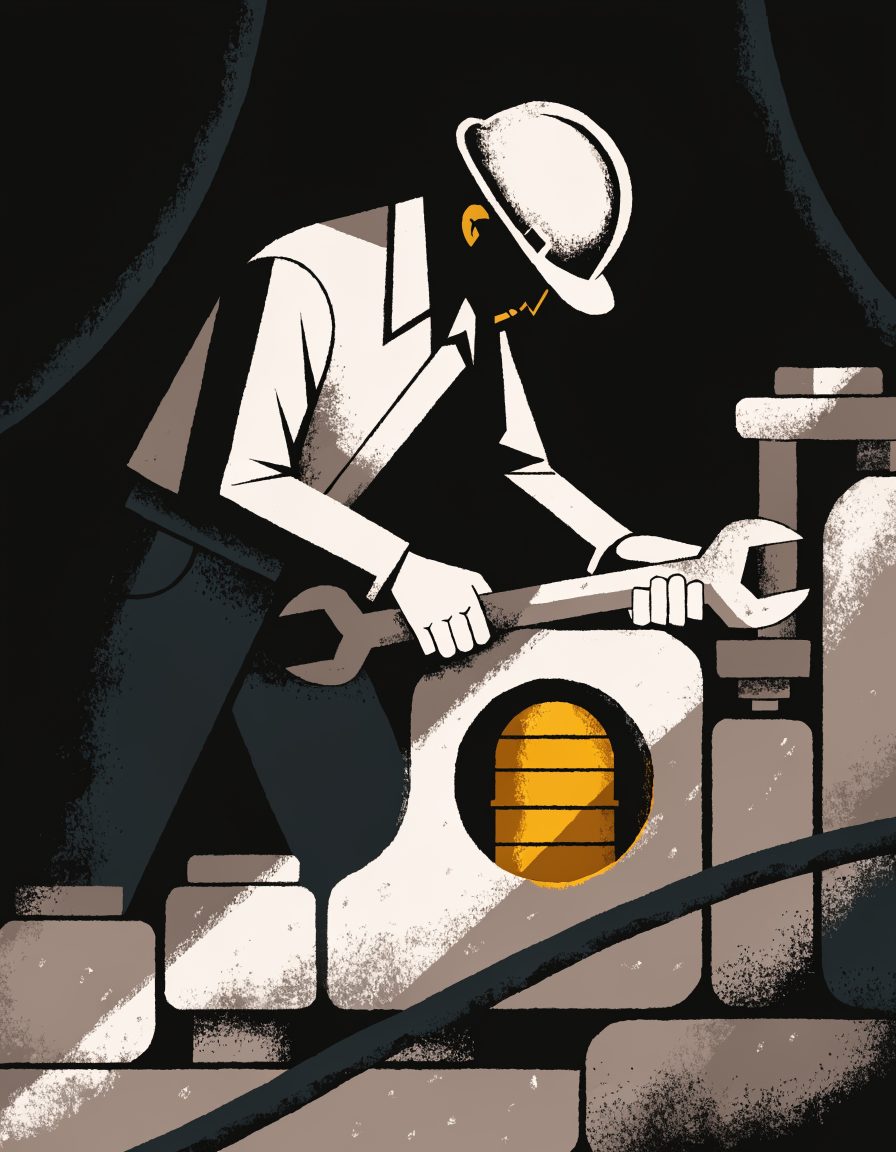
The trade
What a millwright does.
Millwrights install, repair, adjust, assemble, and disassemble industrial machinery on construction sites, including conveyors, turbines, wind turbines, compressors, and production lines. They also fabricate jigs and carry out the lifting, machining, and welding work needed to commission or maintain equipment.
CCQ rate
$47.85 – $50.87 / hour (journeyperson, by sector, April 26, 2026)
Hourly rates are set by the collective agreements of Québec's construction industry and vary by sector: $47.85/h in light residential, $50.20/h in heavy residential, $50.79/h in institutional-commercial and industrial and $50.87/h in civil engineering and roads (journeyperson rate, effective April 26, 2026). Apprentices earn a percentage of that rate depending on their apprenticeship period. Official grids published by the ACQ (residential and institutional-commercial-industrial) and the ACRGTQ (civil engineering and roads).
Source: official ACQ and ACRGTQ rate grids.
Why it's tight
The pool is thin. Speed makes the difference.
In 2024, 1,042 millwrights were active on Quebec job sites, with an average age of 42.7 — a marked sign of an aging workforce and upcoming retirements. New apprentice admissions jumped to 106 in 2024, against a 2020-2023 average of 67 per year, pointing to rising demand but also a replacement pool that's still short. Major industrial and infrastructure projects (wind farms, plants, civil engineering sites) keep steady pressure on recruiting, and 38% of workers in this trade travel between regions to meet demand.
That's exactly where Aplomb wins: Audrey activates candidates in under 2 minutes, 24/7. While others call back the next day, your millwright is already talking to us.
What we check
Before it lands on your desk.
- Hold a CCQ apprentice (CCA) or journeyperson (CCC) competency certificate
- Have passed the General Construction Site Health and Safety course (ASP Construction)
- Practical skill with heavy lifting, rigging, welding, and basic machining
- Ability to read and interpret mechanical drawings, system schematics, and maintenance procedures
- Experience in the industrial or civil engineering sector, particularly on rotating equipment, conveyors, or turbines
Competency card
How a millwright qualifies.
This trade is regulated by the CCQ. Entry into the trade is through the apprentice competency certificate (CCA), issued on presentation of the DEP in Industrial Construction and Maintenance Mechanics (program 5260, 1,800 hours) and a job guarantee of at least 150 hours over 3 consecutive months with a CCQ-registered employer. The apprentice must complete 3 periods of 2,000 hours each (6,000 hours total), then pass the provincial qualification exam to earn the journeyperson competency certificate (CCC). The exam runs 3 hours, covers 61 questions, and requires a 60% pass threshold. The ratio on the books is 2 journeypersons per apprentice in industrial, institutional-commercial, and civil engineering and roads; on site, a minimum of 1 journeyperson per apprentice is required daily.
Frequently asked questions
Hiring a millwright, plainly.
How many apprentices can I have relative to my journeypersons on site?
The ratio on the books is 2 journeypersons per apprentice in industrial, institutional-commercial, and civil engineering and roads. On site, you need at least 1 journeyperson present to supervise 1 apprentice daily. A journeyperson can oversee up to 2 apprentices if the apprentice is in their final period or is a woman. That daily minimum matters in a trade where only 1,042 workers were active in 2024, so ratio flexibility can help you keep training pipelines moving. Since 38% of millwrights travel between regions for work, don't assume your local pool reflects the full number of journeypersons available to your sites. Millwrights on your crew will also typically need to fabricate jigs and handle lifting, rigging, and welding tasks alongside their core mechanical work, so factor that broader skill set into how you structure apprentice supervision.
What card should I require when hiring a millwright?
You need to require either the apprentice competency certificate (CCA) or the journeyperson competency certificate (CCC) issued by the CCQ. Without one of those cards, a worker legally can't work in this trade on CCQ-regulated sites. Beyond the card itself, it's worth confirming practical experience with the specific equipment your site runs — turbines, conveyors, or compressors call for different hands-on skills, and rigging, welding, and basic machining ability aren't always listed on the certificate itself. The ASP Construction health and safety course is also mandatory before a worker steps on site. It's also worth confirming hands-on experience with your specific equipment — conveyors, turbines, wind turbines, compressors, or production lines — since the CCA and CCC alone don't specify which machinery a worker has handled.
Is it hard to find qualified millwrights right now?
Yes, the labour supply is tight. In 2024, only 169 companies were splitting 1,042 active workers, with an average age of 42.7. Retirements are picking up. New apprentice recruitment is rising (106 admitted in 2024), but the 6,000-hour path to journeyperson creates a lag between demand and supply. The upside is that admissions are trending in the right direction — 106 new apprentices in 2024, up from a 67-per-year average in the prior four years. Given 38% of millwrights already travel between regions for work, widening your search beyond your immediate area can help close the gap faster than waiting on new graduates alone. That gap is partly regional too: with 38% of millwrights already travelling between regions for work, a shortage in your immediate area doesn't necessarily reflect the province-wide pool of available journeypersons and apprentices.
Why Aplomb
Why not a generalist agency?
Hiring a millwright isn't something you wing. CCQ specialization changes what you get.
Card verified
We read the CCQ card.
We verify the competency card — apprentice (CCA) or journeyperson (CCC) — before we send you anyone. A generalist doesn't know the difference; on the job site, it changes everything.
Ratios & sectors
We know your ratios.
Your sectors — industrial, civil engineering and roads, institutional-commercial — each have their own apprentice/journeyperson ratio rules. A wrong ratio on the books means a stopped job site. We know them.
Construction only
Zero scatter.
We recruit CCQ-carded construction trades in Québec — not 40 industries at once. It's the talent pool we work every single day.
Get started
Need a millwright?
Leave your info. We'll call you back quickly to understand the role — and tell you how we'll fill it, guarantee included.
- Clear mandate, no surprise quotes.
- 90-day replacement guarantee.
- We respond to candidates in <2 min, 24/7.
Hire a millwright
We'll call you back quickly. No surprise quotes.
Prefer to talk to a human? 1 877 521-6345
Also by region
millwrights in your area.
We recruit across Québec. See the candidate job pages by region for this trade.
Millwright · Greater Montréal
Candidate job page →
Millwright · Montérégie
Candidate job page →
Millwright · Laurentides
Candidate job page →
Millwright · Lanaudière
Candidate job page →
Millwright · Capitale-Nationale (Quebec City area)
Candidate job page →
Millwright · Chaudière-Appalaches
Candidate job page →
Millwright · Outaouais
Candidate job page →
Millwright · Estrie (Eastern Townships)
Candidate job page →
Millwright · Mauricie
Candidate job page →
Millwright · Centre-du-Québec
Candidate job page →
Millwright · Saguenay–Lac-Saint-Jean
Candidate job page →
Millwright · Abitibi-Témiscamingue
Candidate job page →