The trade
What an insulator (lagger) does.
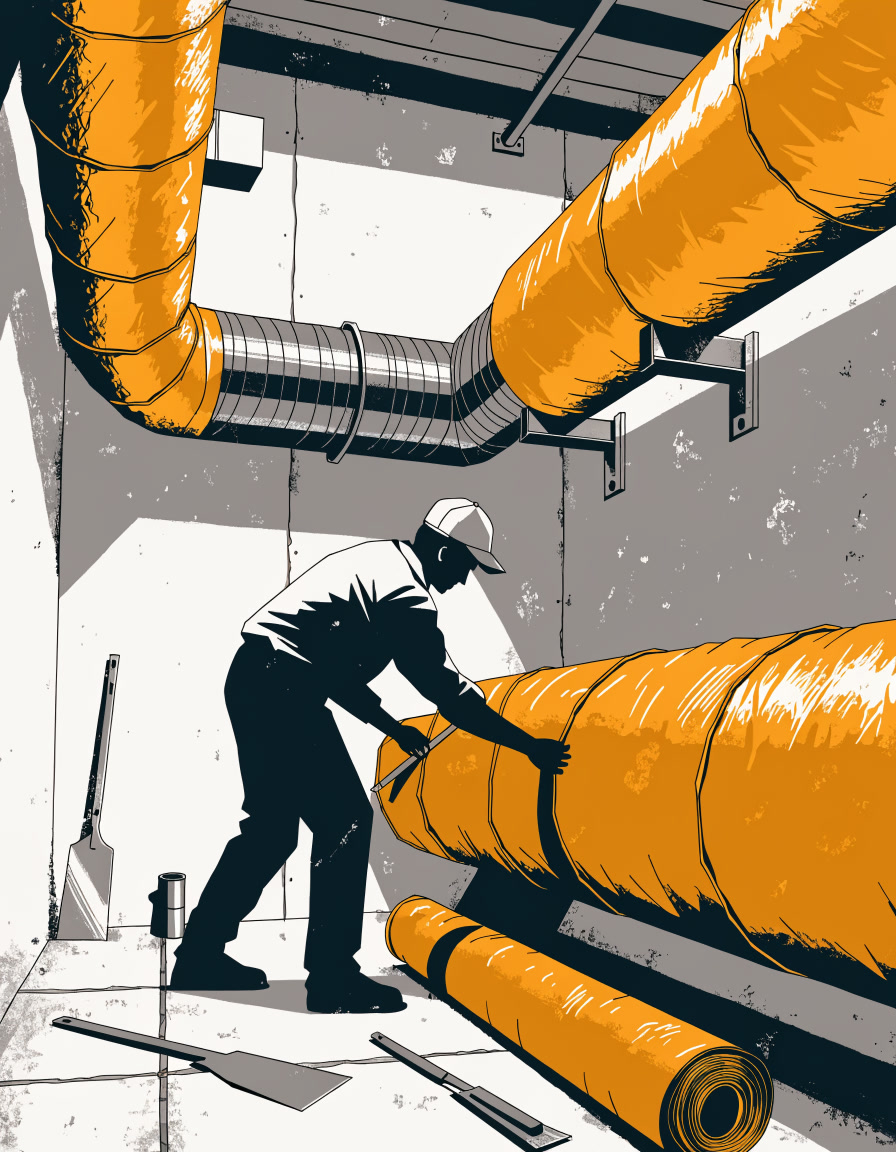
Insulators install, repair, and retrofit thermal insulation systems that maintain the temperature of a liquid or gas. They insulate piping networks, air ducts, and tanks, apply rigid or semi-rigid insulation, and finish the job with protective coverings (vapour barriers, metal jacketing). Most of their work is in institutional-commercial buildings and industrial facilities, often at height and in tight, awkward spaces.
CCQ rate
$47.85 – $50.84 / hour (journeyperson, by sector, April 26, 2026)
Hourly rates are set by the collective agreements of Québec's construction industry and vary by sector: $47.85/h in light residential, $50.20/h in heavy residential, $50.79/h in institutional-commercial and industrial and $50.84/h in civil engineering and roads (journeyperson rate, effective April 26, 2026). Apprentices earn a percentage of that rate depending on their apprenticeship period. Official grids published by the ACQ (residential and institutional-commercial-industrial) and the ACRGTQ (civil engineering and roads).
Source: official ACQ and ACRGTQ rate grids.
Why it's tight
The pool is thin. Speed makes the difference.
The CCQ rates job prospects for insulators as 'excellent': even though demand stays stable, a significantly aging workforce, high turnover, and too few new graduates are creating sustained worker shortages in the market. In 2024, 1,374 insulators were active on Quebec job sites and 141 companies were recruiting. That same year, 141 new apprentices were admitted, above the 2020-2023 annual average of 101, but still modest against the pace of departures. Among journeypersons, the average age is 44.2 and 20% are 55 or older, pointing to a coming wave of retirements. The institutional-commercial sector, which accounts for 81% of hours worked, is expected to stay strong in the coming years.
That's exactly where Aplomb wins: Audrey activates candidates in under 2 minutes, 24/7. While others call back the next day, your insulator (lagger) is already talking to us.
What we check
Before it lands on your desk.
- Valid CCQ competency certificate (apprentice or journeyperson) — mandatory to work on job sites governed by the R-20 Act
- ASP Construction card (general health and safety on job sites) — required to obtain the CCQ competency certificate
- Completed DEP in Insulation (5378, 900 hours) or a CCQ-recognized equivalent
- Skilled at insulating piping, air ducts, and tanks, installing rigid or semi-rigid insulation, and applying protective finishes (vapour barriers, metal jacketing)
- Experience in the institutional-commercial or industrial sector (99% of hours worked in the trade), comfortable working at height and in tight, awkward spaces
Competency card
How an insulator (lagger) qualifies.
Insulators must hold a CCQ competency card. The apprentice certificate (CCA) is issued after completing the DEP in Insulation (5378, 900 hours, offered in the Montreal area) and presenting a job guarantee of at least 150 hours over 3 consecutive months with a CCQ-registered employer. The apprenticeship covers 3 periods of 2,000 hours each (6,000 hours total), after which the apprentice can sit the provincial qualification exam leading to the journeyperson certificate (CCC). In the institutional-commercial, industrial, and civil engineering sectors, the ratio on the books is 2 journeypersons per apprentice; in residential, it's 1:1. On any given workday, the minimum required ratio is 1 journeyperson per apprentice.
Frequently asked questions
Hiring an insulator (lagger), plainly.
How do I check that an insulator I want to hire is in good standing with the CCQ?
You can verify a worker's competency certificate directly through the CCQ's online services. It's a quick step to run before hiring — a worker without a valid certificate (CCA apprentice or CCC journeyperson) can't legally work on your R-20-regulated job sites. While you're at it, confirm they hold their ASP Construction card (general health and safety on job sites), a mandatory requirement to obtain the CCQ competency certificate. The market is competitive: in 2024, 141 companies were recruiting insulators from a pool of only 1,374 active workers. Make sure your offer reflects experience in the sector you're targeting — institutional-commercial (81% of hours) or industrial (18%) — to attract the right candidates quickly.
How many apprentice insulators can I have per journeyperson on my job site?
In the institutional-commercial, industrial, and civil engineering sectors, the CCQ ratio on the books is 2 journeypersons per apprentice; in residential, it's 1:1. On any given workday, the minimum ratio you need to respect is 1 journeyperson per apprentice. A journeyperson can supervise a second apprentice if one of the two is in their final apprenticeship period or is a woman — insulators, who go through 3 apprenticeship periods, aren't excluded from this option, unlike crane operators and other single-period trades. Always check the exact ratio for your sector on ccq.org. This ratio exists to ensure proper supervision across the 6,000 apprenticeship hours spread over 3 periods of 2,000 hours each.
Is it hard to recruit qualified insulators right now?
Yes, the pool is small and under pressure. In 2024, 141 companies were recruiting insulators against only 1,374 active workers, and the CCQ rates the trade's prospects as 'excellent' — a sign that demand outpaces supply. Aging is a factor: among journeypersons, the average age is 44.2 and 20% are 55 or older, pointing to a coming wave of retirements. The 141 new apprentices admitted in 2024 top the 101-per-year average for 2020-2023, but the 6,000-hour path to journeyperson qualification creates a lag between demand and supply. To widen your pool, post on the CCQ's workforce dashboard (releve.ccq.org), reach out to the training centre offering the DEP in Insulation in Montreal, or work with a construction-focused recruiting agency.
Why Aplomb
Why not a generalist agency?
Hiring an insulator (lagger) isn't something you wing. CCQ specialization changes what you get.
Card verified
We read the CCQ card.
We verify the competency card — apprentice (CCA) or journeyperson (CCC) — before we send you anyone. A generalist doesn't know the difference; on the job site, it changes everything.
Ratios & sectors
We know your ratios.
Your sectors — institutional-commercial, industrial, civil engineering and roads, residential — each have their own apprentice/journeyperson ratio rules. A wrong ratio on the books means a stopped job site. We know them.
Construction only
Zero scatter.
We recruit CCQ-carded construction trades in Québec — not 40 industries at once. It's the talent pool we work every single day.
Get started
Need an insulator (lagger)?
Leave your info. We'll call you back quickly to understand the role — and tell you how we'll fill it, guarantee included.
- Clear mandate, no surprise quotes.
- 90-day replacement guarantee.
- We respond to candidates in <2 min, 24/7.
Hire an insulator (lagger)
We'll call you back quickly. No surprise quotes.
Prefer to talk to a human? 1 877 521-6345
Also by region
insulators (laggers) in your area.
We recruit across Québec. See the candidate job pages by region for this trade.
Insulator (Lagger) · Greater Montréal
Candidate job page →
Insulator (Lagger) · Montérégie
Candidate job page →
Insulator (Lagger) · Laurentides
Candidate job page →
Insulator (Lagger) · Lanaudière
Candidate job page →
Insulator (Lagger) · Capitale-Nationale (Quebec City area)
Candidate job page →
Insulator (Lagger) · Chaudière-Appalaches
Candidate job page →
Insulator (Lagger) · Outaouais
Candidate job page →
Insulator (Lagger) · Estrie (Eastern Townships)
Candidate job page →
Insulator (Lagger) · Mauricie
Candidate job page →
Insulator (Lagger) · Centre-du-Québec
Candidate job page →
Insulator (Lagger) · Saguenay–Lac-Saint-Jean
Candidate job page →
Insulator (Lagger) · Abitibi-Témiscamingue
Candidate job page →