Recruitment · Welder
Hire a welder in Québec.
We'll find you a carded, qualified welder who's actually interested — not a pile of resumes. Permanent placement, 90-day guarantee, no surprise quotes.
The trade
What a welder does.
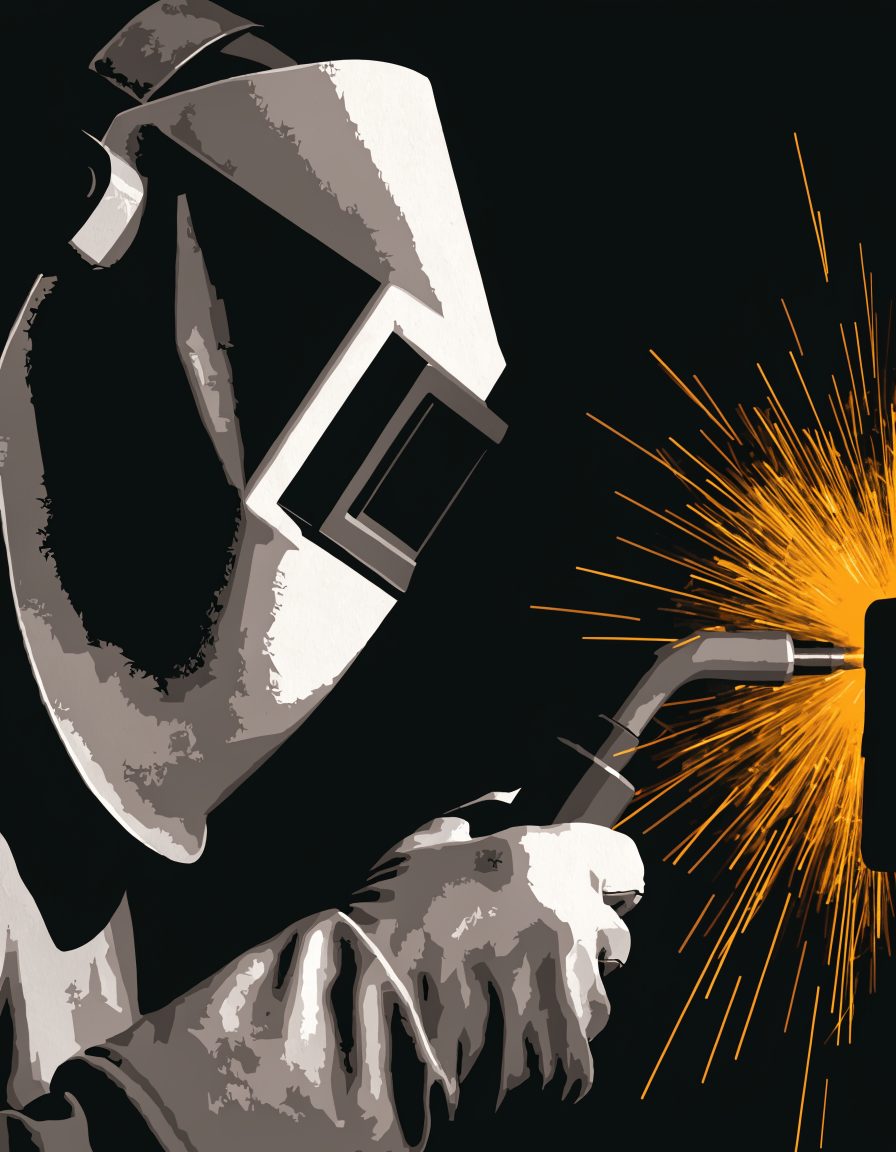
Welders interpret specs and welding procedures, carry out prep work, then cut, prepare, and assemble metal parts using various welding processes to build structural elements on construction sites. They work mainly in civil engineering and roads, and in institutional-commercial.
CCQ rate
$45.34 – $49.38 / hour (journeyperson, by sector, April 26, 2026)
Hourly rates are set by the collective agreements of Québec's construction industry and vary by sector: $45.34/h in light residential, $47.57/h in heavy residential, $47.40/h in institutional-commercial and industrial and $49.38/h in civil engineering and roads (journeyperson rate, effective April 26, 2026). Apprentices earn a percentage of that rate depending on their apprenticeship period. Official grids published by the ACQ (residential and institutional-commercial-industrial) and the ACRGTQ (civil engineering and roads).
Source: official ACQ and ACRGTQ rate grids.
Why it's tight
The pool is thin. Speed makes the difference.
Per CCQ data (2024), only 377 welders were active in Quebec's construction industry, spread across 154 companies — and only 24 new workers entered the trade that year, below the 2020-2023 average of 37 per year. The CCQ projects recruitment needs of 17,000 people per year across the industry for 2024-2028 (up 1,000 from prior projections), driven by an aging workforce and growth in major projects. About 44% of active welders travel between regions to find work — a sign of geographically concentrated but persistent demand.
That's exactly where Aplomb wins: Audrey activates candidates in under 2 minutes, 24/7. While others call back the next day, your welder is already talking to us.
What we check
Before it lands on your desk.
- Hold a valid occupation competency certificate (CCO) issued by the CCQ
- Master arc welding processes and metal cutting and prep techniques
- Completed the General Construction Site Health and Safety course (ASP Construction)
- Hold a CWB (Canadian Welding Bureau) certification or pressure vessel qualification for industrial or pipefitting roles
- Ability to read welding plans and specs and adjust parameters by material and process
Competency card
How a welder qualifies.
Welders hold an occupation competency certificate (CCO) issued by the CCQ — there's no formal apprenticeship period with a journeyperson ratio like in the traditional trades. To get the CCO, the worker must have completed a DEP in Welding-Fitting (1,800 hours, codes 5195 or 5695) and passed the General Knowledge of the Construction Industry course (CCGIC). A job guarantee of at least 150 hours over 3 months is also required for admission. For high-pressure work, a Professional Specialization Attestation (ASP) in high-pressure welding (600 hours) is required to work as a pipe welder. The CCQ also runs a Welding Qualification Fund that reimburses exam fees tied to CWB (Canadian Welding Bureau) certifications or pressure vessel qualifications required by employers.
Frequently asked questions
Hiring a welder, plainly.
How many welders are available in Quebec's construction industry?
The pool is small: 377 active welders in 2024, spread across 154 companies. Only 24 new workers entered the trade that year. This is a trade under real pressure — plan ahead and start recruiting early. Part of the constraint is structural: welders need both a DEP in Welding-Fitting and the CCGIC course before they're even eligible for the occupation competency certificate. With 44% of active welders already working outside their home region, casting a wider geographic net is often necessary just to fill a single position. Given the CCQ projects a need for 17,000 new recruits per year across the industry through 2028, and only 24 new welders entered the trade in 2024, competition for anyone holding a valid occupation competency certificate is likely to stay fierce for the foreseeable future.
Can a construction welder work unsupervised on site?
A welder with a journeyperson-level occupation competency certificate (CCO) can work independently. The CCO is issued by the CCQ after a DEP and the CCGIC — verify your candidate's card is current before hiring, it's a legal requirement on sites governed by the R-20 Act. For industrial or pipefitting work specifically, also check whether the job requires a CWB certification or pressure vessel qualification — some contracts require them outright. With only 377 active welders across the whole province in 2024, a worker holding those extra credentials is worth prioritizing when you find one. Since the trade covers everything from arc welding and metal prep to reading specs and adjusting parameters by material, verifying a candidate's CCO alone doesn't guarantee they can handle every process — ask about their specific experience before assigning them unsupervised work.
Do I have to pay for the welding certifications (CWB, pressure vessel) I require from my welder?
If you require a welding certification because of the nature of your work, the CCQ's Welding Qualification Fund can reimburse certain costs to the employee (travel, lodging, exam fees). It costs you nothing directly, and it helps attract and retain strong candidates. That's a meaningful advantage in a trade this tight: only 24 new workers entered in 2024, against 154 companies competing for 377 active welders overall. Pointing candidates toward the Welding Qualification Fund during hiring conversations can be the deciding factor when they're weighing your offer against another employer's. With only 24 new welders entering the trade in 2024 against 154 companies competing for 377 active workers, covering certification costs through the fund is a low-cost way to stand out to a candidate weighing several offers in a very tight market.
Why Aplomb
Why not a generalist agency?
Hiring a welder isn't something you wing. CCQ specialization changes what you get.
Card verified
We read the CCQ card.
We verify the competency card — apprentice (CCA) or journeyperson (CCC) — before we send you anyone. A generalist doesn't know the difference; on the job site, it changes everything.
Ratios & sectors
We know your ratios.
Your sectors — civil engineering and roads, institutional-commercial, industrial, residential — each have their own apprentice/journeyperson ratio rules. A wrong ratio on the books means a stopped job site. We know them.
Construction only
Zero scatter.
We recruit CCQ-carded construction trades in Québec — not 40 industries at once. It's the talent pool we work every single day.
Get started
Need a welder?
Leave your info. We'll call you back quickly to understand the role — and tell you how we'll fill it, guarantee included.
- Clear mandate, no surprise quotes.
- 90-day replacement guarantee.
- We respond to candidates in <2 min, 24/7.
Hire a welder
We'll call you back quickly. No surprise quotes.
Prefer to talk to a human? 1 877 521-6345
Also by region
welders in your area.
We recruit across Québec. See the candidate job pages by region for this trade.
Welder · Greater Montréal
Candidate job page →
Welder · Montérégie
Candidate job page →
Welder · Laurentides
Candidate job page →
Welder · Lanaudière
Candidate job page →
Welder · Capitale-Nationale (Quebec City area)
Candidate job page →
Welder · Chaudière-Appalaches
Candidate job page →
Welder · Outaouais
Candidate job page →
Welder · Estrie (Eastern Townships)
Candidate job page →
Welder · Mauricie
Candidate job page →
Welder · Centre-du-Québec
Candidate job page →
Welder · Saguenay–Lac-Saint-Jean
Candidate job page →
Welder · Abitibi-Témiscamingue
Candidate job page →